HKN EngineeringEngineering simulation
and design support
Discuss a project

Behind architecture
— physics

Understand wind, airflow and heat before construction. Choose designs that support comfort and make a sound investment.

Talk to an engineer

Trusted by our clients

Developers, design teams
and clients with complex buildings.

HKN in numbers

41projects
92,000m² analysed
12years of experience

An engineering question
A reasoned decision

Bring simulation into the decisions that shape your project: select details, assess systems and compare alternatives before construction.

Computational fluid dynamics

Understand airflow
Design with confidence

Explore the service

Computational fluid dynamics simulates the movement of liquids and gases. For building applications, we calculate airflow, pressure and heat transfer to assess comfort, ventilation and equipment performance.

What we assess
External aerodynamics: urban wind flow, wind directions and local acceleration at entrances, courtyards and passages.
What your design team receives
Velocity, pressure and temperature fields at relevant sections; an analysis of problem areas, scenario comparisons and proposals for modifying geometry or systems. We explain which design parameter affects the outcome and how to use the findings.
Stack effect

Height connects
every floor

Explore the service

In cold weather, differences in indoor and outdoor air density create pressure differences along a building’s height. We analyse stack effect to coordinate entrances, vertical connections and ventilation.

What we assess
Vertical pressure distributions and neutral pressure levels under selected temperature conditions.
What your design team receives
Pressure profiles, airflow paths and values across selected doors and zone boundaries. We compare the original scheme with proposed measures, identify the most influential air connections and provide findings for architects and building services engineers.
Energy modelling

Invest today
Operate for years

Explore the service

Compare building options through energy demand and consumption. See how investment in the envelope and systems relates to future operating costs.

What we assess
Heating and cooling demand profiles, heat-gain and heat-loss balances, seasonal and peak loads.
What your design team receives
Energy balances and load profiles, with options compared against agreed indicators. The economic assessment includes initial and operating cost components, stated assumptions and sensitivity to tariffs, schedules and the evaluation horizon.
Temperature fields

Keep heat
where it belongs

Explore the service

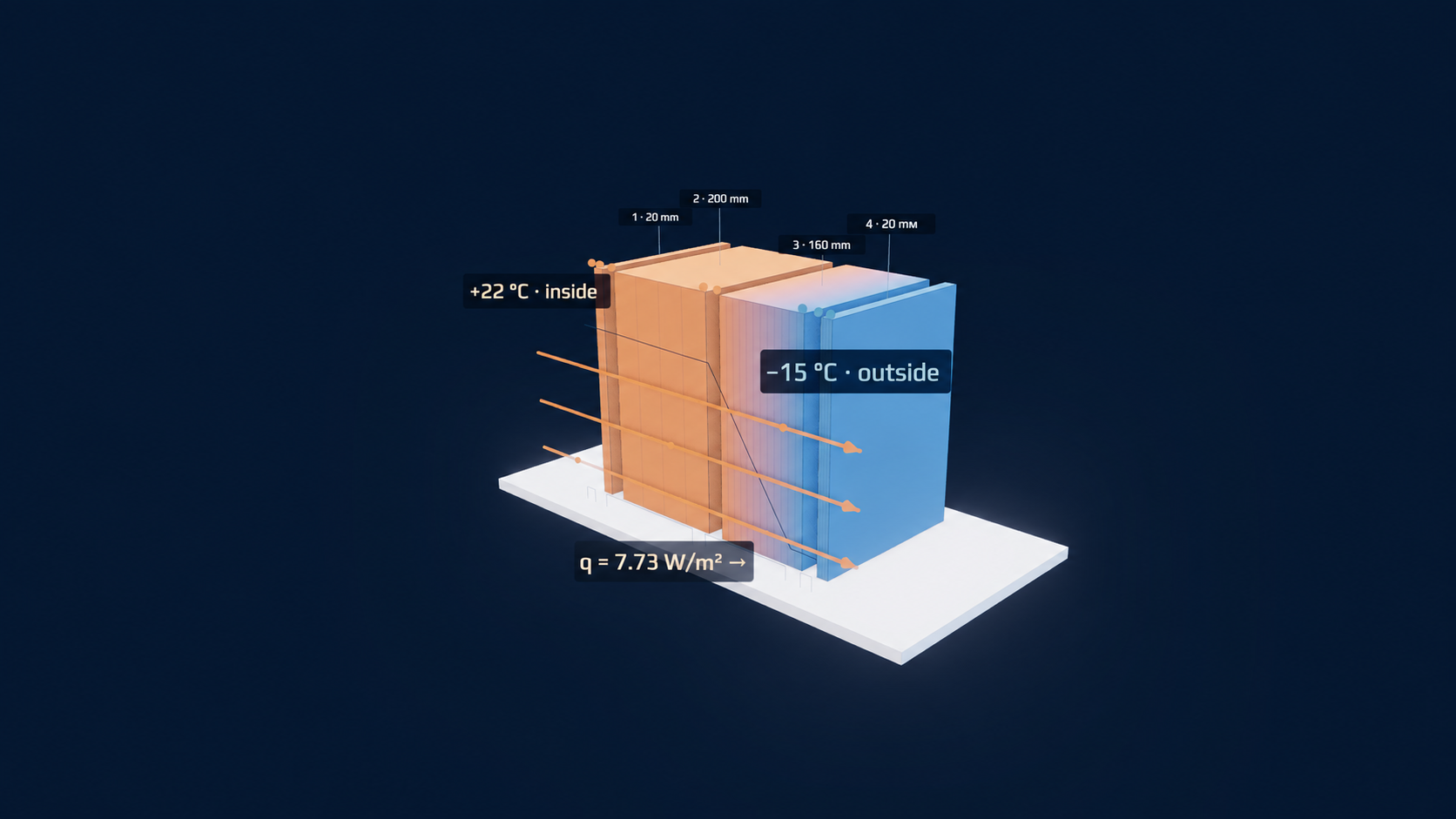
A flat wall and a real façade junction behave differently. We calculate temperature fields to assess junctions, fixings and mixed-material assemblies before construction details are finalised.

What we assess
Steady-state two- and three-dimensional temperature fields, heat fluxes and local thermal bridges.
What your design team receives
Model definition and boundary conditions, temperature and heat-flux maps, values at selected sections, option comparisons and recommendations for refining the detail. These results support coordination between architects, structural engineers and façade specialists.
Engineering modelling

Test the decision
Then build

Explore the service

Turn an engineering question into a calculation model. Understand how geometry, materials and operating conditions affect a building, and which option deserves further development.

What we assess
Problem definition: identify the decision, variables and performance indicators to compare.
What your design team receives
An agreed modelling approach, scenario results and a comparison of performance indicators. We explain which changes affect the outcome, which inputs are decisive and what to carry into the next design stage.

A single detail or an unusual operating condition?
Start with the question your project needs to answer.

Discuss a project

Invest today
Operate for years

Compare initial investment and operating costs over the same period. Energy modelling connects a technical decision with the cost of ownership.

Your comparison starts with an energy model,
option costs and operating conditions.

Discuss an energy model
Illustration of a temperature field through a façade construction

Illustrative study · heat transfer through a façade

Calculations that
support decisions

Before work starts, we define the answer your design team needs and how the results should be delivered.

  • A clear problem definition

    Input data, calculation scenarios and comparison criteria.

  • Comparable alternatives

    How performance changes with geometry, systems and operating conditions.

  • A decision for your project

    Findings, recommendations and materials for coordination with the wider design team.

Where we
have worked

Different climates, building types and operating conditions. Explore the cities where our projects have taken place.

From the first question
to a design decision

Speak directly with an engineer. Together we define the task, then agree the scope, schedule and fee.

  1. 01

    Discuss the task

    The building, design stage and decision that needs assessment.

  2. 02

    Agree the scope

    Inputs, alternatives, criteria and deliverables.

  3. 03

    Calculate and compare

    Assess scenarios and discuss the effect of design parameters.

  4. 04

    Deliver the findings

    Explain the conclusions and how to use them in your project.

Before our
first conversation

Do we need a finished technical brief?

A description of the building and your question is enough to begin. Plans, sections or a model help us identify the required inputs more quickly.

When should HKN join a project?

When an engineering question or alternative design options arise. Earlier involvement gives more opportunity to influence architecture, details and systems.

What determines the fee and schedule?

The complexity of the building, available inputs, number of scenarios and deliverables. We discuss the task and agree the scope of work.

Can we start with one detail or scenario?

Yes. We can assess a specific task or support the wider design team, depending on the outcome you need.

Start with
your project

Tell us which decision you need to check.
Discuss the task with an engineer.

info@hkn.pro+7 (917) 706-00-40Telegram · @HKN_Engineering ↗

A finished brief is not required.
Attach plans or a model to your email.

Your enquiry will be sent to info@hkn.pro. Privacy policy